

Shipibo Designs and the Living Geometry of Icaros
Shipibo designs are far more than decorative patterns. They belong to a sophisticated visual language known as "Kené", developed and preserved by the Shipibo-Konibo people of the Peruvian Amazon. Kené is closely connected with the wider Shipibo world of plant knowledge, ceremonial practice, music, perception, and cosmology. The patterns are among the most immediately recognisable expressions of Shipibo culture, yet their meaning extends far beyond their striking geometric appearance.
Within Shipibo understanding, pattern, sound, vision, and order can be experienced as deeply interconnected. This is one reason Kené is frequently discussed in relation to the sacred ceremonial songs known as "Icaros". It is sometimes stated that a Shipibo healer sings a pattern and a woman then reproduces that exact song in embroidery. This is an attractive explanation, but it is too literal. Kené and Icaros are better understood as parallel expressions of a shared system of knowledge rather than as direct translations of one another.
In many modern descriptions, Shipibo art is compared with synesthesia, in which normally separate senses such as sound, colour, movement, and form become intertwined. The comparison can help outsiders understand why music and geometry are so closely associated within Shipibo ceremonial experience. However, the Western concept of synesthesia does not fully describe the Shipibo understanding. Within their own cultural framework, the relationship between song and pattern belongs to a much broader perception of an ordered and interconnected world.
Icaros, Vision, and Ceremonial Knowledge
Icaros are sacred songs used by Shipibo healers within ceremonial practice. They may be sung for guidance, protection, cleansing, strengthening, or the restoration of balance. The songs are not simply performances or expressions of personal emotion. Within Shipibo tradition they are regarded as working elements of ceremonial practice, acquired and refined through apprenticeship, discipline, experience, and relationships with plants.
A healer may possess many Icaros, each used according to the circumstances of a ceremony or the needs of a participant. Some are associated with particular plants, while others may be used for protection, opening or closing ceremonial work, strengthening a process, or creating a particular atmosphere or direction within the ceremony.
Within traditional Shipibo understanding, an Icaro may be experienced as something received rather than consciously composed. Healers sometimes describe learning songs through dreams, visions, periods of isolation, or during relationships established with particular plants. In this sense, the healer does not necessarily consider himself the author of the song, but its recipient and eventual carrier.
The exact explanations vary between healers, families, and lineages. It is therefore more accurate to understand Icaros as part of a living tradition rather than as a fixed system in which every song has a universally defined meaning.
The Master Plant Dieta
An important part of the training of many Amazonian healers is the practice commonly known as a Master Plant Dieta. During such periods, a person enters a disciplined relationship with a particular plant or tree, often accompanied by dietary restrictions, isolation, reduced social contact, sexual abstinence, and careful attention to dreams, sensations, and altered states of perception.
The purpose of a Dieta is not simply to consume a plant. Within the traditional understanding of the practice, it is a way of learning from it. Over time, the person may become familiar with what is understood as the character, qualities, teachings, or spirit of the plant. Some healers describe receiving Icaros during these periods and regard the songs as part of the knowledge transmitted through the relationship.
Dietas may vary greatly in duration and intensity. Some last days or weeks, while more demanding periods of apprenticeship may continue for months. Experienced practitioners may undertake numerous Dietas throughout their lives, gradually developing relationships with different plants and expanding their ceremonial knowledge.
This tradition helps explain why Icaros are so often described as songs belonging not simply to the singer, but to a larger field of plant and ceremonial knowledge.
Icaros and the Patterns
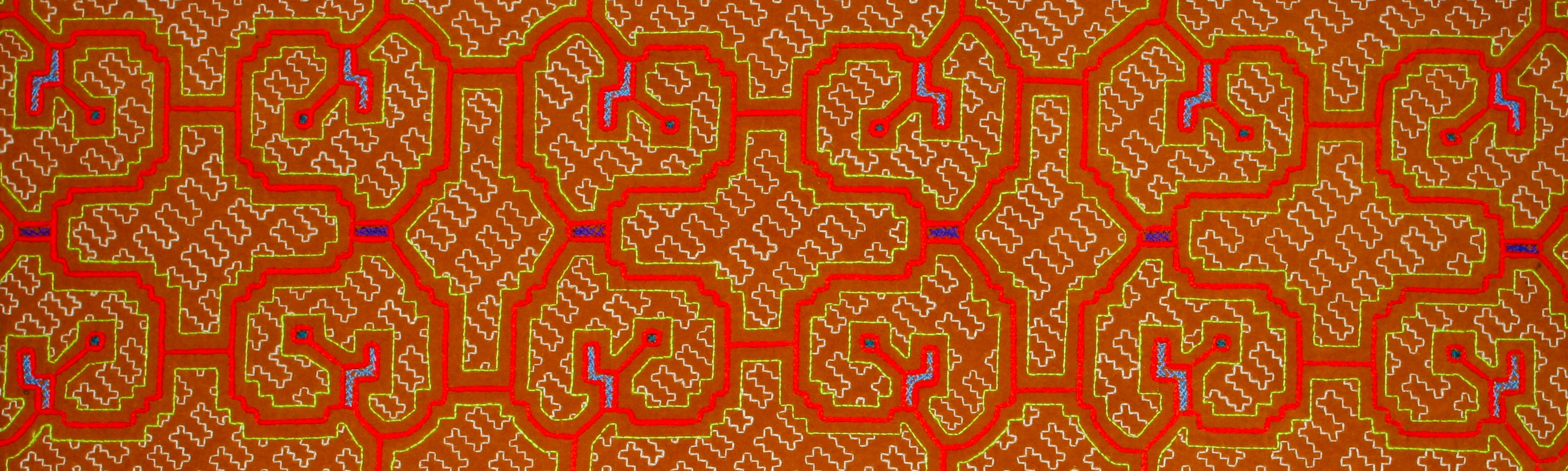
The relationship between Icaros and Kené is one of the most fascinating aspects of Shipibo culture. In ceremonial and visionary contexts, healers may describe songs, lines, movements, and geometric forms as interconnected aspects of the same experience. Pattern may be perceived while a song is being sung, while the rhythm and structure of a song may itself be understood as possessing form.
For this reason, Kené is sometimes described as the visual equivalent of an Icaro. This can be useful as a poetic explanation, but should not be interpreted to mean that every textile is a literal musical score that can simply be read and sung. The relationship is more subtle. Both pattern and song express rhythm, continuity, balance, movement, and order through different senses.
Traditional accounts also describe women singing while creating designs and artisans working within an environment where song, memory, and pattern are naturally connected. The finished textile can therefore belong to the same cultural world as Icaros without representing the notation of one specific song.
Ayahuasca and the Visionary Dimension
"Ayahuasca" holds an important place within Shipibo ceremonial practice, particularly in the training and work of many healers. During Ayahuasca ceremonies, practitioners may experience complex visual phenomena including networks, flowing lines, grids, interlocking geometries, and repeating structures that can strongly resemble Kené.
Within Shipibo ceremonial understanding, these patterns may be interpreted as expressions of an underlying order that exists beyond ordinary perception. Ayahuasca is therefore sometimes described not as creating the patterns, but as allowing aspects of this order to become visible.
Icaros play an essential role during these ceremonies. Through song, healers traditionally understand themselves to guide and structure the ceremonial process, protect participants, respond to disturbances, and encourage the restoration of balance. Pattern and sound can consequently become closely intertwined within the visionary experience.
It is important, however, not to reduce Kené to Ayahuasca imagery. Kené is a cultural tradition in its own right, transmitted particularly through generations of Shipibo women. Women do not need to participate in Ayahuasca ceremonies in order to create or understand the designs, and many learn their patterns through family, observation, memory, and repeated practice.
Ayahuasca therefore provides one important context in which the relationship between pattern, perception, and Icaro becomes especially visible, but it is not the sole source of Kené.
Kené: Pattern as Knowledge
Kené is traditionally associated particularly strongly with Shipibo women, who have been its principal artists and transmitters. Girls commonly begin learning from mothers, grandmothers, and other women in their families while still young. What begins with observation and simpler designs can gradually develop into an ability to construct highly complex patterns from memory.
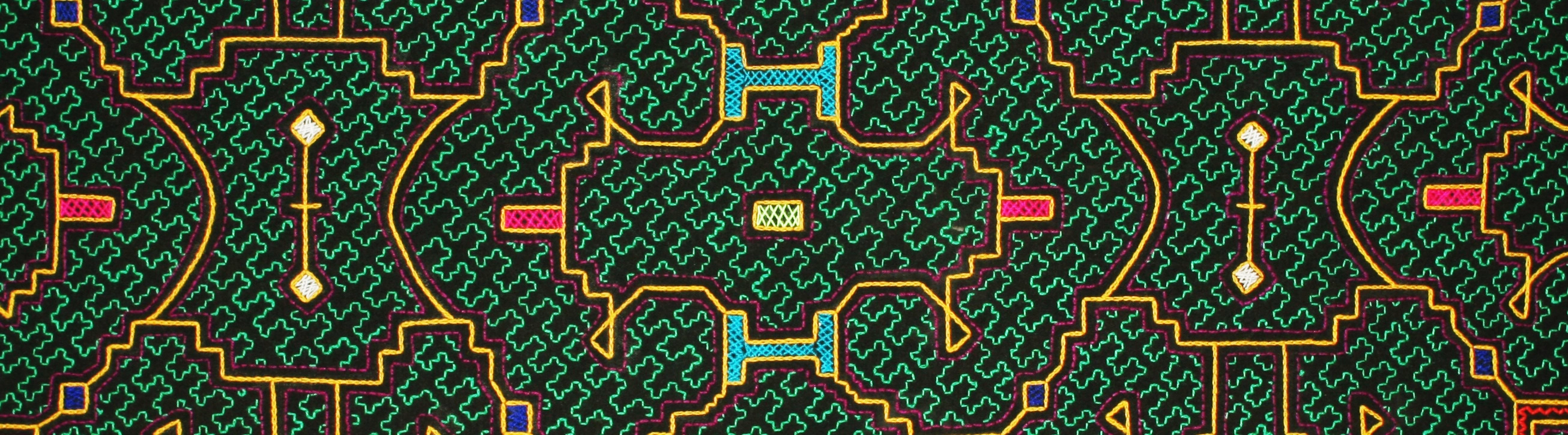
The designs are not simply copied mechanically from templates. Experienced artists understand the visual principles from which a composition can be developed. Lines turn, divide, reconnect, surround open spaces, and create larger structures containing increasingly smaller forms. Balance is maintained across the entire composition even where individual sections appear highly irregular or complex.
This creates the characteristic impression that a Kené design might continue indefinitely beyond the edge of the cloth. The visible textile becomes one section of a larger imagined pattern rather than a conventional picture enclosed within a frame.
Individual creativity remains important. Although the artistic language is inherited, each woman can develop her own compositions and recognisable manner of working. Kené therefore combines continuity of tradition with personal artistic expression.
Painted and Embroidered Kené
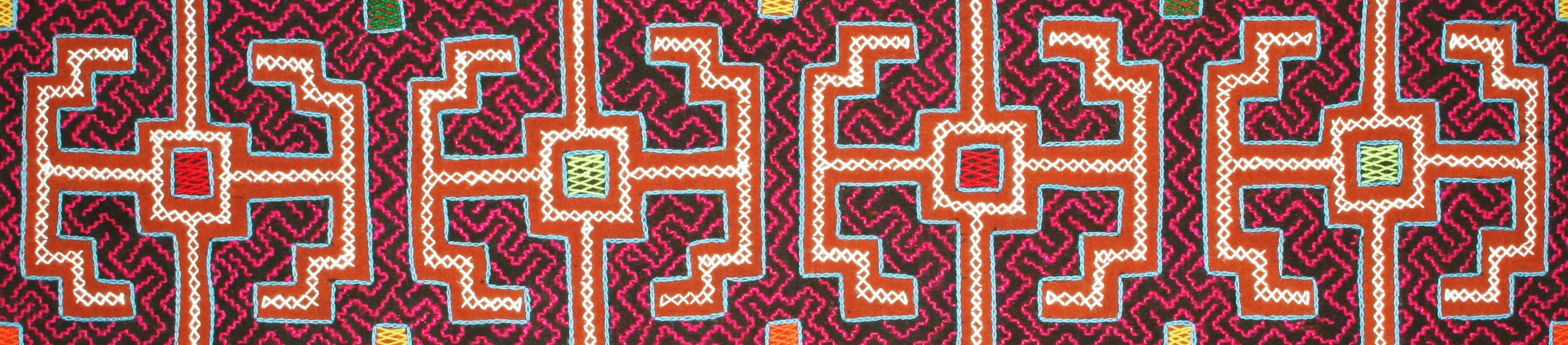
Kené appears in several forms. Some of the most remarkable examples are painted directly onto cotton cloth, while others are created through extremely detailed hand embroidery using coloured thread. Designs are also found on ceramics, beadwork, clothing, ceremonial objects, and other surfaces.
Painted textiles traditionally make use of pigments and dyes prepared from locally available materials. The resulting colour palette can include deep earthy browns, blacks, reddish tones, and contrasting areas of untreated or lightly coloured fabric. Embroidered work allows a very different visual expression, with brightly coloured threads creating sharp contrasts and intricate linear structures.
Contemporary Shipibo artists also work with commercially available cotton, thread, dyes, and paints. The introduction of modern materials does not mean the artistic tradition has disappeared. Kené has continually adapted while retaining its distinctive visual structure and cultural identity.
The difference between painted and embroidered pieces is particularly striking when examined closely. Painted designs often have a flowing, organic quality created directly by the movement of the hand, while embroidery produces an extraordinary density and precision through thousands of individual stitches.
Learning the Designs
The transmission of Kené traditionally takes place within families and communities rather than through formal written instruction. A young girl may watch older women work, gradually attempt sections herself, and build confidence and complexity through repetition.
Over time the principles of balance, spacing, turning lines, and overall composition become internalised. An experienced artist may create a complex design without first drawing a complete plan. The pattern develops progressively while still maintaining coherence across the whole textile.
This ability demonstrates that Kené is not simply a collection of decorative motifs. It is a visual system learned through years of practice. Experienced makers recognise when lines, proportions, or relationships between sections feel balanced or disturbed, much as an experienced musician recognises whether musical phrases belong together.
Design, Identity, and Individual Expression
Although Kené belongs to a shared Shipibo artistic language, individual designs are not necessarily fixed symbols with one universally recognised translation. Popular descriptions sometimes claim that each pattern has a single specific meaning, such as abundance, wisdom, protection, or healing. Such interpretations may occur in particular contexts, but it is misleading to treat Kené as a simple dictionary in which every line or motif corresponds with one predetermined meaning.
The significance lies more broadly in relationships of harmony, beauty, identity, continuity, protection, and ordered form. A design can carry intention and cultural meaning without functioning like a written sentence or collection of individual symbols.
The personal creativity of the artist is also fundamental. Two women working within the same tradition may create completely different compositions. This makes every handmade textile an individual work while still remaining immediately recognisable as Shipibo Kené.
Function Rather Than Decoration Alone
Within Shipibo cultural and ceremonial understanding, Kené is not regarded solely as decoration. Pattern can be associated with order, protection, beauty, balance, and the proper arrangement of people, objects, and spaces.
In this context, references to Kené as a form of visual medicine are best understood culturally rather than medically. The pattern may traditionally be regarded as participating in the creation or maintenance of harmony. It does not simply illustrate harmony as a symbol; within the traditional worldview it forms part of the ordered environment itself.
This helps explain why Kené appears across so many different aspects of Shipibo material culture. A pattern may surround the body in clothing, cover a vessel, occupy a textile within a home, or appear on an object associated with ceremony. Pattern becomes part of the space in which life takes place.
Textiles as Cultural Objects
Shipibo textiles can serve practical, artistic, social, and ceremonial purposes. Larger cloths have traditionally been produced for clothing and household use, while other pieces may be created specifically as decorative works or for exchange and sale.
The dimensions, materials, colours, and degree of complexity can vary greatly. Some designs occupy almost the entire cloth, producing a dense field of interconnected geometry, while others allow larger areas of background to become part of the composition.
Older pieces can also reveal changes in available materials and artistic preferences. Cotton quality, thread, dyes, colour combinations, and the intended market have changed over time, while the underlying visual language remains unmistakably connected with Kené.
This makes older textiles particularly interesting not only as decorative objects but also as records of individual craftsmanship and a particular period within an evolving artistic tradition.
The Shipibo-Konibo People
The Shipibo-Konibo are an Indigenous people of the Peruvian Amazon, with their traditional territory centred primarily along the Ucayali River and its tributaries. Their culture is known for sophisticated artistic traditions, extensive plant knowledge, ceremonial practices, music, and a worldview in which relationships between human beings, plants, animals, landscape, and unseen dimensions of existence are deeply interconnected.
Despite centuries of colonial pressure, missionary influence, displacement, changing economies, and increasing contact with wider Peruvian society, Shipibo-Konibo culture has demonstrated remarkable continuity. At the same time, it has never been completely static. Shipibo people continue to adapt, create, travel, trade, teach, and reinterpret their traditions in response to changing circumstances.
Kené is an important example of this continuity. What was once encountered primarily within communities along the Ucayali is today recognised internationally. Shipibo artists exhibit their work, sell textiles and paintings, produce contemporary artworks, and bring their visual language into new settings while maintaining connections with the tradition from which it originates.
Contemporary Kené and the Outside World
The international growth of interest in Ayahuasca has brought extraordinary attention to Shipibo imagery. Kené patterns now appear far beyond the Peruvian Amazon on clothing, jewellery, album artwork, retreat centres, websites, tattoos, and numerous commercial products.
This popularity has helped create economic opportunities for Shipibo artists, but it also raises questions about attribution and cultural appropriation. A pattern can easily be copied digitally while becoming detached from both its maker and the cultural tradition from which it developed.
For this reason, it is important to recognise Kené not merely as an attractive psychedelic aesthetic or generic symbol of Ayahuasca. It is the artistic language of a living Indigenous people, maintained and developed by generations of Shipibo-Konibo artists.
Respect begins with acknowledging that origin and recognising the individuals and communities whose cultural knowledge has made these extraordinary designs possible.
A Living System of Transmission
Perhaps the most remarkable aspect of Kené is that there is no need to choose between describing it as art, knowledge, pattern, ceremony, or cultural identity. Within the Shipibo world these categories can overlap.
A woman embroidering a textile, a healer singing an Icaro, and a person describing geometries experienced during Ayahuasca are not necessarily performing versions of the same act. Yet each participates in a cultural understanding in which rhythm, perception, repetition, relationship, and order possess profound significance.
This is why the familiar statement that the shaman sings the pattern and the woman embroiders it is simultaneously beautiful and incomplete. There is a genuine relationship between Icaro and Kené, but it is richer than a direct translation from music into drawing.
Song and pattern can instead be understood as parallel expressions of a world in which knowledge may be heard, seen, learned, remembered, embodied, and transmitted. One moves through voice and breath, another through line, colour, and the movement of the hand.
Kené is therefore neither simply decoration nor a mysterious code waiting for outsiders to decipher. It is a living visual tradition: disciplined yet creative, inherited yet continually renewed, and inseparable from the people who have carried it across generations.
Context Note / Disclaimer
When this article refers to healing, medicine, plants, Ayahuasca, Icaros, protection, energetic functions, or ceremonial effects, it does so within the cultural and ceremonial understanding of the Shipibo-Konibo people. These descriptions are not intended as medical claims, nor as substitutes for modern healthcare. They are shared to provide insight into a living Indigenous knowledge system, not to prescribe or promote therapeutic use.
Copyright Notice
All written content in this article is protected under copyright law. Reproduction or distribution of the text, in whole or in part, without prior written permission is prohibited.
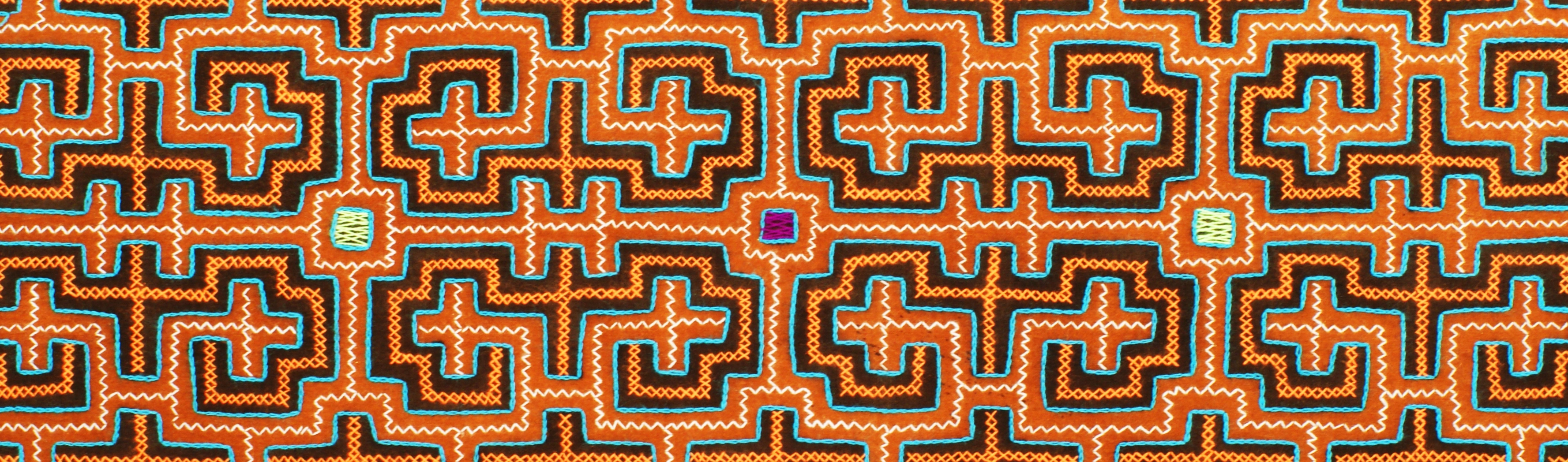
Photographs and images shown may represent Indigenous artwork or cultural expressions. These works are not claimed as original creations of this publication. Copyright, authorship, and cultural ownership remain with the Indigenous artists or communities from which they originate.